Key takeaways
- Measure your TV's actual width corner to corner. A 65 inch TV is about 143 cm wide, not the diagonal number on the box.
- Aim for a soundbar between 70 and 100 percent of that width as a starting point, not a rule.
- Stand depth gets missed far more often than width, and a bar over about 12 cm deep can block a TV's front sensor.
- Open plan rooms change how a correctly sized bar sounds, independent of whether the size itself was right.
- Wall mounting removes the shelf edge comparison that makes a narrower bar look undersized on a stand.
A customer called me back four days after I fitted his new bar to say it looked cheap next to his television, even though the sound itself was fine. The bar was a perfectly good 5.1 model. It was also about 20 cm narrower than his TV stand, so it sat in the middle like an accessory rather than part of the setup.
Sizing a soundbar wrong does not usually break the sound. It breaks the look, or it puts the bar somewhere it blocks a sensor, or it leaves a shelf deep enough for the bar but too shallow once a subwoofer needs floor space beside it.
None of this is complicated once you treat it as arithmetic rather than instinct. Three measurements, one working range, and a handful of exceptions cover almost every living room and bedroom setup you will run into.
The measurements that actually decide this
Three numbers matter, and only one of them is on the soundbar’s own spec sheet. TV screen width, corner to corner along the bottom edge, not the diagonal size printed on the box. Stand or shelf depth, from the wall or the TV’s back to the front edge. And the height clearance under the screen if the bar sits on a shelf rather than the floor.
A 55 inch TV measures close to 121 cm wide. A 65 inch measures about 143 cm. A 77 inch measures roughly 170 cm. Manufacturers advertise diagonal size because it sounds larger, but width is what your soundbar actually has to share space with.
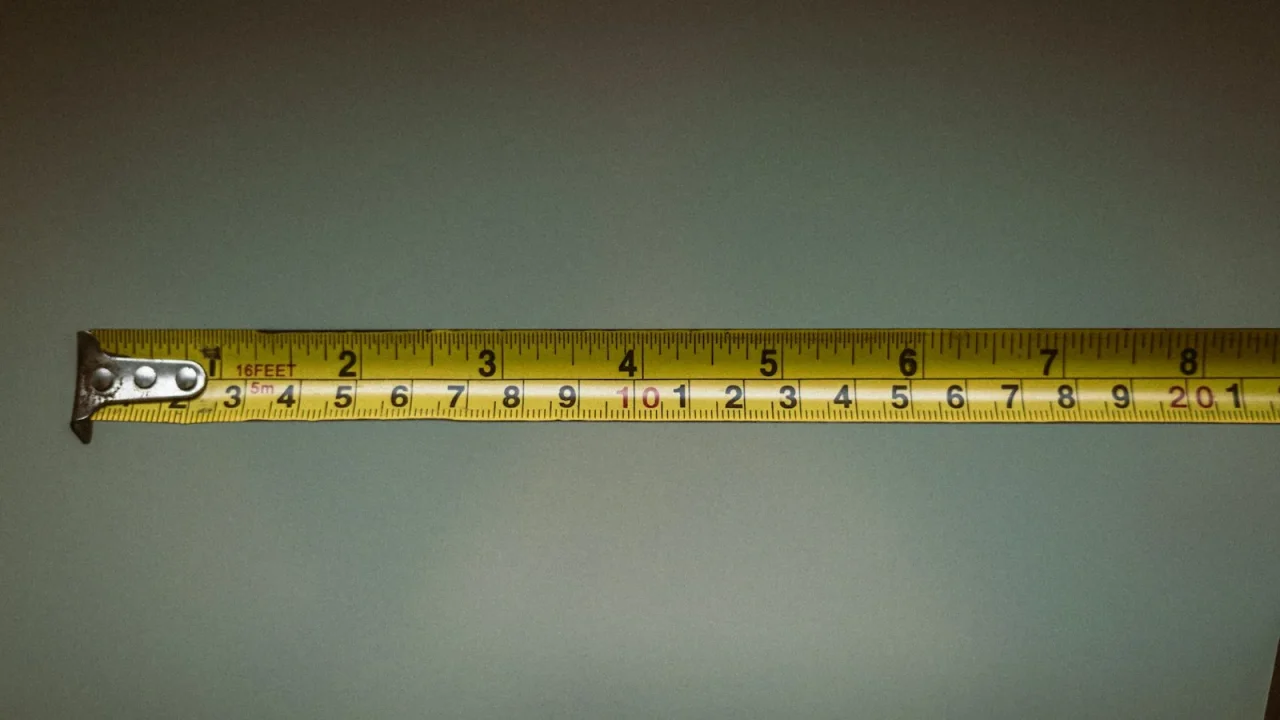
The conversion is consistent enough to remember: a 16 by 9 screen’s width works out to roughly 87 percent of its diagonal measurement. A quick way to check without a formula is simply running a tape measure along the bottom bezel, corner to corner, which takes less time than looking up the conversion in the first place.
The rule of thumb, and where it breaks down
The working range most installers use is 70 to 100 percent of screen width for the bar itself. Go narrower than 70 percent and the bar visually disappears under a large screen. Go wider than 100 percent and it starts overhanging the stand, which becomes a real hazard once a curious toddler or a careless elbow is involved. That range is not an arbitrary preference. It comes from decades of cinema and hi fi cabinetry being built to sit visually subordinate to the screen it accompanies, never wider, rarely much narrower.
| TV size | Approx screen width | Comfortable bar width range |
|---|---|---|
| 43 inch | 95 cm (37 in) | 66 to 95 cm |
| 55 inch | 121 cm (48 in) | 85 to 121 cm |
| 65 inch | 143 cm (56 in) | 100 to 143 cm |
| 77 inch | 170 cm (67 in) | 119 to 170 cm |
That range is a starting point, not a rule carved in anything. A slim bar under a much larger TV can still look intentional if it is mounted on the wall rather than a stand, since wall mounting removes the visual comparison a shelf creates.
Manufacturers list soundbar width to the millimetre but rarely list depth clearly. Check depth against your own stand before ordering, not after the box arrives.
A 43 inch TV in a small bedroom
A 43 inch TV is about 95 cm wide, so the comfortable bar range works out to roughly 66 to 95 cm. Almost any compact soundbar fits that, and in a bedroom under about 12 square metres, a 2.1 model with a small built in woofer is usually enough. A separate subwoofer in a room this size often has nowhere to go that does not put it under the bed or against a wall it will rattle.
Viewing distance in a bedroom is also usually short, often 1.5 to 2.5 metres from a bed or a small sofa to the screen, which means a compact bar’s narrower dispersion still covers the seating position easily. There is rarely a reason to spend more here than a decent 2.1 or 3.1 model.
A genuinely small apartment tightens all of this further, since floor space, shared walls, and a single room often doing double duty as living room and bedroom rule out models that would be fine in a house. Choosing the right bar for a small apartment covers those extra constraints on top of the sizing arithmetic here.
A 65 inch TV in an open plan living room
A 65 inch TV at 143 cm wide wants a bar between about 100 and 143 cm, which covers most mid range 5.1 and 7.1.2 models, the kind of layout Dolby documents in its own consumer guide to Atmos. The complication here is rarely the bar itself. Open plan rooms swallow bass and scatter reflections, so a bar that sounded full in a boxed in living room can sound thin here.
That is a room acoustics problem layered on top of a sizing one, and it is worth reading how open plan rooms change what you hear before assuming the bar itself is at fault.
Seating distance tends to run longer in these rooms too, often 3 to 4.5 metres from a sectional sofa to the screen, which is exactly the range where a correctly sized bar’s stereo image starts to narrow. Sitting further back rewards a slightly wider bar within the comfortable range, not a narrower one, since the extra width helps hold the stereo spread together across the room.
A 77 inch OLED with a floor standing bar
A 77 inch screen runs close to 170 cm wide. Very few soundbars are made that wide, so the honest range becomes about 120 to 150 cm, sitting proportionally smaller than the 70 to 100 percent rule suggests, and that is fine. At this screen size the bar reads as an accessory to the picture rather than competing with it, so slightly undersized looks more intentional than slightly oversized.
Floor standing placement changes the depth question entirely. Without a shelf lip to worry about, the constraint becomes distance from the seating position and whether the bar’s tweeters fire at ear height rather than up at your shins. For a full placement walkthrough by room shape, see getting the basics of soundbar placement right.
A large screen also forgives a size mismatch more than a small one does, since the eye is drawn upward to the picture rather than down to the shelf beneath it. That is worth remembering if a genuinely wide model is out of budget and a slightly narrower one is the honest choice.
When width was never the real problem
Occasionally a customer measures everything correctly and the bar still looks or sounds wrong. Usually the actual issue is depth, not width, a bar 12 to 14 cm deep sitting on a stand shelf only 15 cm deep, leaving no room for cables or blocking the TV’s front facing infrared sensor. I have been called out for a remote that stopped working entirely, only to find the new soundbar’s raised top edge sitting directly across the sensor window on the TV’s bottom bezel.
Wall mounting sidesteps most of this, at the cost of visible brackets and a cable run to hide. The comparison between the two approaches, including what each does to the sound, is covered in wall mounting versus shelf placement. Whichever you choose, measure the depth before the width, because depth is what actually gets missed.
Specs that matter beyond size, driver count, port layout, and connection type, are covered separately in soundbar specs that actually matter, and if you have not settled on the bar itself yet, how to choose a soundbar for your room covers the rest of that decision, so sizing does not have to double as a full buying guide on its own.
None of this arithmetic replaces standing in the room with a tape measure before you buy. Photos on a retailer’s website flatten scale in ways that make a bar look either larger or smaller than it will actually feel sitting under your own television, so treat the ranges here as a shortlist, not a final answer.
Questions readers ask about this
Mostly looks, with one exception. A cabinet too narrow for its driver count can force tweeters closer together than ideal, narrowing the stereo image slightly. For nearly every consumer bar under about 130 cm, the size difference you notice from the couch is visual rather than acoustic.
A 50 inch TV measures close to 110 cm wide. Aim for a bar between about 77 and 110 cm, the 70 to 100 percent range installers use as a starting point. Slightly narrower looks fine on a wall mount. Slightly wider starts to overhang most stands.
Yes, mostly through bass. A large bar or subwoofer pushing deep output into a room under about 12 square metres can overload the space with low frequency energy before the volume even feels loud, which reads as boomy rather than powerful. Size for the TV first, then listen for that before assuming bigger is better.
Measure it yourself. Manufacturers print the diagonal screen size, which is a marketing convention, not the width your soundbar actually sits beside. A tape measure across the bottom bezel takes thirty seconds and avoids buying a bar that is a size category off.
Yes. A bar that looks undersized on a stand, sitting below a visible gap of shelf on either side, often looks intentional once wall mounted directly under the screen, because there is no shelf edge left to compare it against. It is one reason a slightly narrower bar bothers people less on a wall than on a stand.

About the author
Rahul Gupta
Rahul Gupta has spent nearly a decade quietly wiring living rooms, testing soundbars in every awkward apartment layout imaginable, and untangling the kind of HDMI handshake problems that make people give up on Atmos altogether. He writes here about what actually works when you get the boxes home—not what the spec sheet promises. If a piece of gear on this site earns a recommendation, it earned it in a real room with real furniture, not a lab.