Key takeaways
- Floor area under 15 square metres often needs no separate subwoofer at all, while 15 to 25 square metres is where a small one earns its space.
- A ceiling above about 3 metres or below 2.3 metres both work against up firing Atmos drivers, which are tuned for roughly 2.4 to 2.7 metres.
- Two or three shared walls, common in a mid building unit, matters more to subwoofer choice than the floor area number alone.
- An open plan kitchen and living space scatters bass differently than an enclosed room of the identical floor area.
- A second subwoofer and a 7.1.4 layout are rarely worth it below about 25 square metres of combined floor area.
A customer in a top floor studio called me two weeks after installing a 7.1.4 flagship bar, not because it sounded bad but because his downstairs neighbour had already knocked on the door twice about bass coming through the floor. The bar was excellent. It was also sized for a house, not the 24 square metre open plan space he actually lived in.
The opposite mistake happens just as often: a compact 2.1 bar bought for a studio that turns out to have an open plan kitchen bleeding noise into the same room, leaving dialogue thin under the extractor fan and the neighbour’s television through the wall. Sizing an apartment soundbar wrong rarely means silence. It means bass in the wrong place or clarity that runs out under real conditions.
Getting this right is arithmetic, not guesswork: floor area, ceiling height, how many walls are shared with someone else, and how the room is actually shaped decide most of it before a single spec sheet gets opened.
The four variables that actually decide apartment sizing
Floor area comes first. Under about 15 square metres, a soundbar’s own driver, reaching down to somewhere between 60 and 90 Hz, is often already enough without adding a separate subwoofer at all. Between 15 and 25 square metres, a small wireless sub earns its space. Above that, particularly in an open plan layout, treat the combined floor area, not just the seating area, as the number that matters.
Ceiling height decides whether Atmos height channels are worth paying for at all. A flat, hard ceiling under roughly 2.7 metres gives up firing drivers something to bounce off. Many apartment ceilings sit closer to 2.3 to 2.4 metres, which still works, but a sloped or very high loft ceiling above about 3 metres scatters that reflection and wastes the spend, a point covered in full at ceiling height and Atmos and documented generally by Dolby’s own placement guidance.
Shared walls are the variable a TV sized buying guide never accounts for. One shared wall changes almost nothing about which bar to buy. Two or three shared walls, common in a mid building unit rather than a corner flat, changes how loud and how low you can comfortably run a subwoofer regardless of what the bar itself is capable of.
Room shape matters last but still matters. An open plan studio with the kitchen and living space sharing one volume of air loses bass and scatters dialogue differently than an enclosed one bedroom living room of the exact same floor area, which is why two apartments measuring the same on paper can need genuinely different bars.
Soft furnishings shift the picture further still. A studio with a single rug and bare walls reflects sound very differently from one with a heavy sofa, curtains, and a carpeted floor, and the second version generally forgives a smaller, cheaper bar more readily than the first one does.
The arithmetic in plain numbers
Start with floor area in square metres, not the number of bedrooms, since a studio and a one bedroom flat can have living areas of very similar size. Just measure the actual room the television sits in, including any open kitchen or dining area with no wall separating it.
Match that number to a channel count using the same logic covered in channel counts explained: under 15 square metres, a 2.1 or 3.1 bar; 15 to 25 square metres, a genuine 5.1 layout if the budget allows it; above 25 square metres in an open plan layout, treat it closer to a small living room than a bedroom and size accordingly, following the same guidance in how to choose a soundbar for your room.
Then subtract for shared walls. Each additional shared wall beyond one is a reason to favour a smaller built in subwoofer over a larger separate one, or to plan on running night mode and a lower crossover setting more often than the specification sheet alone would suggest.
A 28 square metre open plan studio
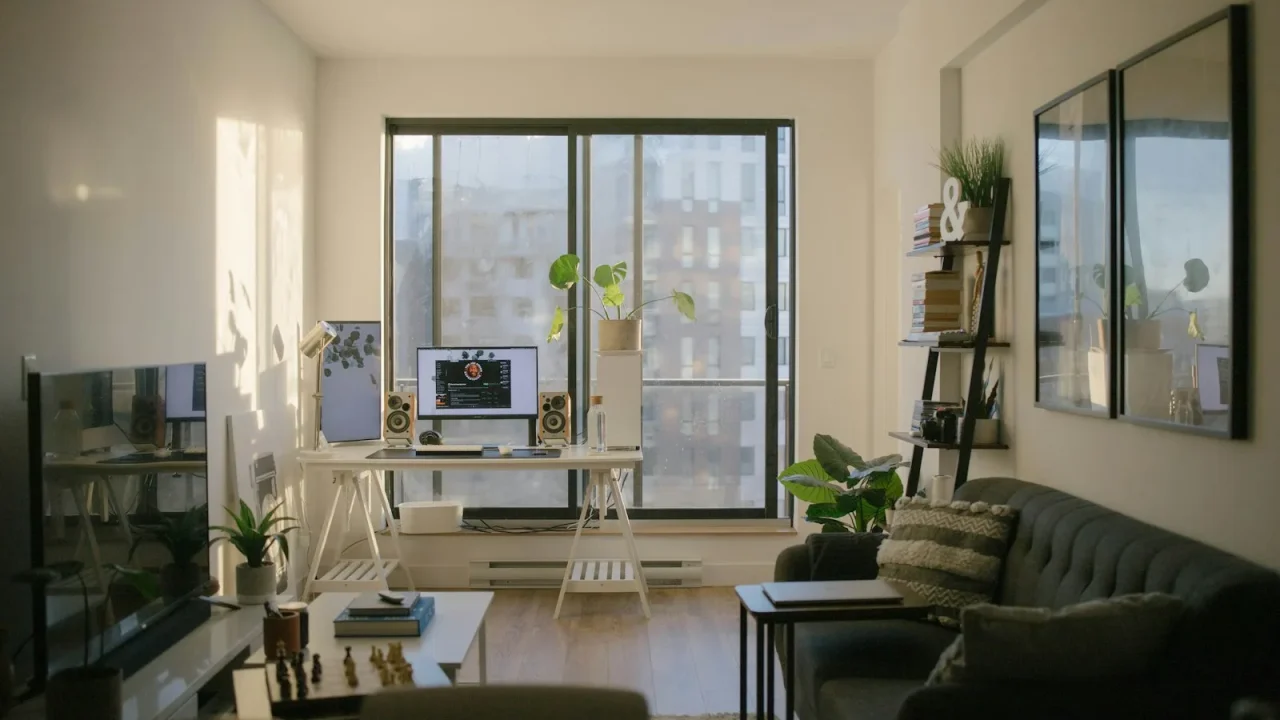
An open plan studio around 28 square metres, kitchen and living area sharing one room, with a single shared wall to a neighbouring unit, is the layout I see most often in city apartment blocks. The seating distance here typically runs 1.8 to 2.5 metres from a sofa to the screen, close enough that a compact bar’s dispersion covers it easily.
A 3.1 or entry 5.1 bar with a modest built in or small wireless subwoofer suits this well. Open plan rooms scatter bass and reflections more than an enclosed space of the same size, so a slightly higher volume setting is often needed just to match what an enclosed room would deliver at a lower one, worth knowing before assuming the bar itself is underpowered.
A 20 square metre enclosed one bedroom living room
An enclosed one bedroom living room around 20 square metres, with proper walls on all sides rather than an open kitchen, holds bass and dialogue far more predictably. Two shared walls, common in a mid floor unit rather than a corner or top floor one, is the more typical constraint here than floor area itself.
A genuine 5.1 bar, something in the range of a Klipsch Flexus system, works well in this size room, paired with a subwoofer kept a reasonable distance from the shared walls and a crossover set slightly higher than default to reduce how much low frequency energy actually reaches the neighbours, covered fully in whether a subwoofer is worth adding at all.
A 16 square metre room with a 3 metre loft ceiling
A converted loft style apartment with a small footprint, around 16 square metres, but a ceiling running close to 3 metres, is the case people most often size wrong in either direction. The temptation is to buy a flagship 7.1.4 bar to match the tall, dramatic ceiling.
The floor area, not the ceiling height, decides the main channel count here. A 2.1 or 3.1 bar still suits the room’s actual footprint, and height channels are a genuine gamble at 3 metres since most up firing drivers are tuned for reflection off a ceiling closer to 2.4 to 2.7 metres. Even the Sonos Arc Ultra, capable enough to reach further than most bars into this taller space, cannot fully overcome a ceiling built taller than the format was designed around.
What to skip entirely in a space this size
Skip a second subwoofer regardless of the room, since almost no apartment sized space needs more low end than one properly placed unit provides, and a second one mostly adds phase cancellation and neighbour complaints rather than genuine depth.
Skip a 7.1.4 or larger layout unless the floor area genuinely exceeds about 25 square metres, since the extra rear and height channels have nowhere to sit apart from each other in anything smaller, and the same budget spent on a well matched 5.1 system consistently produces a more noticeable improvement in an apartment sized room.
Skip wall mounted rear speakers in a rental where drilling is not allowed, rather than assuming a workaround exists. Adhesive mounts and small shelf stands exist for exactly this situation, and forcing a bracket into a wall you do not own tends to cost far more at move out than the mount itself would have.
An older rental television without an eARC port is worth checking before anything else, since a bar relying on optical alone is limited to Dolby Digital 5.1, with no Atmos or DTS:X regardless of channel count, a limitation covered at the HDMI Forum’s own specification pages and worth confirming on your specific TV before buying based on the room alone.
None of these variables replace standing in the actual room with a tape measure and, ideally, a neighbour you are on speaking terms with. Floor area gets you most of the way there. Shared walls decide the rest.
Questions readers ask about this
No. A correctly sized subwoofer kept away from shared walls, combined with a slightly higher crossover setting, keeps most low frequency energy contained well within normal apartment living. Problems usually come from an oversized subwoofer pushed to full output in a small room, not from having bass at all, and scaling the unit to the actual floor area avoids most complaints.
Usually, but not automatically. A studio with an open plan kitchen bleeding noise into the living space can still need a genuine 5.1 layout rather than a basic 2.1 model, since ambient noise from cooking or an extractor fan competes with dialogue more than in a fully enclosed room of the same size.
Generally yes, since apartment seating distances tend to run shorter, often under 2.5 metres, and shared walls limit how loud you can comfortably run the system regardless of what it is capable of. A bar rated for a much larger room is rarely a problem in an apartment. It is simply headroom you will not use much.
Yes, and many apartment dwellers do exactly that. Night mode compresses the gap between quiet dialogue and loud effects, which reduces peak bass and volume spikes that travel through shared walls, at the cost of some dynamic range during action scenes. It is a reasonable permanent setting where neighbours are a bigger concern than peak dynamic range.
Measure it. Up firing drivers are tuned for reflection off a flat, hard ceiling roughly 2.4 to 2.7 metres up, and a loft style apartment with a ceiling closer to 3 metres or higher will scatter that reflection rather than bounce it back down cleanly, making the height effect noticeably weaker than the same bar would produce in a standard apartment.

About the author
Rahul Gupta
Rahul Gupta has spent nearly a decade quietly wiring living rooms, testing soundbars in every awkward apartment layout imaginable, and untangling the kind of HDMI handshake problems that make people give up on Atmos altogether. He writes here about what actually works when you get the boxes home—not what the spec sheet promises. If a piece of gear on this site earns a recommendation, it earned it in a real room with real furniture, not a lab.