Key takeaways
- Seated eye height on a normal sofa runs about 95 to 115 cm off the floor, and a soundbar's front tweeters need to sit close to that line for dialogue to arrive at full strength.
- Mounting a TV over a fireplace typically lifts a shelf-mounted soundbar 25 to 40 cm above ear height, which measurably reduces energy in the 4 to 10 kHz range where speech clarity lives.
- Bass is barely affected by mounting height because low frequencies radiate in almost every direction, which is why a too-high soundbar can still feel loud while dialogue goes missing.
- A tilting bracket costing $30 to $90 fixes the actual geometry problem, while a new soundbar or an added subwoofer, the two purchases people usually make instead, rarely help.
- Where a TV genuinely cannot be relocated, a low-mounted center channel or a soundbar with an adjustable driver angle recovers most of the lost clarity without touching the wall bracket.
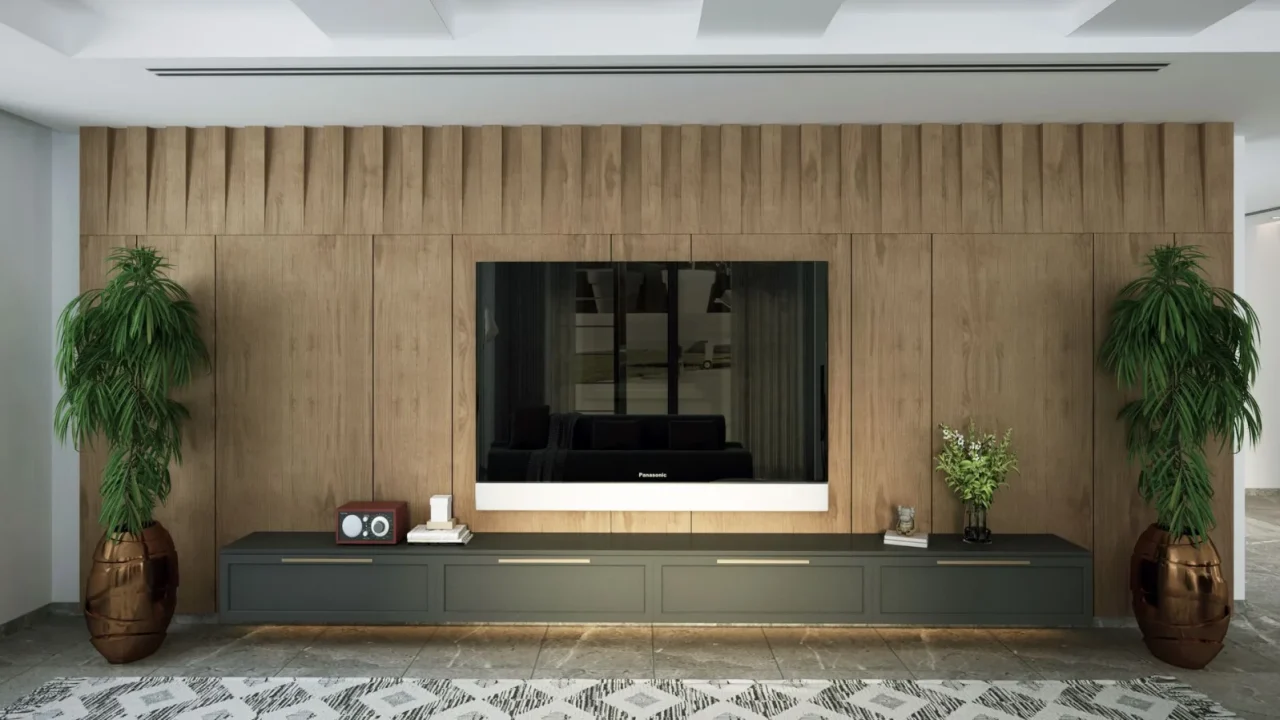
The TV goes up first, centered on the chimney breast because that is where the bracket holes were drilled long before anyone thought about sound, and it lands 155 cm off the floor measured to the middle of the screen. The soundbar sits on a narrow shelf underneath, its tweeters roughly level with the mantel and about 40 cm above where anyone’s head actually is once they sit down.
Six months later the household is convinced the soundbar has gone wrong. Dialogue sounds thin against the score, effects seem to come from somewhere behind the screen rather than from the bar itself, and turning the volume up only makes the problem louder rather than clearer.
Nothing about the electronics has failed. What changed is geometry, not hardware. A soundbar’s front drivers throw sound in a fairly narrow, forward-facing pattern, and once that pattern is aimed a third of a metre above a seated listener’s ears, a meaningful share of the frequencies that carry speech simply passes overhead.
Where your ears actually are when the film starts
Seated eye height on an ordinary sofa lands somewhere between 95 cm and 115 cm off the floor, depending on the sofa and the person sitting on it. That number matters here because it is also, roughly, where a soundbar’s tweeters need to be aimed for direct sound to reach a listener without losing energy to the ceiling on the way.
A TV mounted so its centre sits at 155 cm, a common result of centring it on a fireplace breast rather than on the seating, puts a soundbar shelf-mounted underneath at around 130 to 140 cm. That is 25 to 40 cm above ear height for most seated adults, which sounds small until you consider how directional a tweeter’s output actually is.
Console or low-stand setups mostly avoid this problem, since the TV and speakers naturally sit closer to seated ear height already. The mismatch shows up almost entirely in over-the-fireplace and high-shelf installs, which is also where a technician gets called out most often for a system that used to sound fine and apparently stopped.
Why treble beams and bass does not
A soundbar’s tweeter, typically handling frequencies from around 2 kHz upward, radiates in a narrow beam that narrows further as frequency rises. Move 20 to 30 degrees off that beam’s axis and output at 8 kHz can drop 6 to 10 dB, enough to make the consonant sounds in speech, the parts that actually carry intelligibility, thin out or vanish.
Bass behaves almost the opposite way. Below roughly 300 Hz, wavelengths are long enough that sound radiates in nearly every direction regardless of where the driver points, which is why a subwoofer tucked in a corner still fills a room evenly while a soundbar aimed at the ceiling starves the seats below it.
This is close cousin to the reason up-firing Atmos height channels are so sensitive to ceiling height and shape. Dolby’s own technology overview covers why placing a height channel correctly depends on precise geometry, not just having the driver present, and the same logic carries straight over to a soundbar mounted too high for the seats it serves.
That asymmetry is the whole story. A soundbar mounted too high still delivers bass normally, so a listener’s ear registers the system as working, since low end is felt as much as heard, while dialogue and detail, riding on the directional frequencies, quietly miss the seat.
What actually changes once the bar sits above your ears
Two identical Samsung HW-Q990D units, one mounted at ear height on a low console and one on a shelf 35 cm above a fireplace mantel, measure differently from the same seat with nothing else changed. In real installs, a handheld SPL meter typically shows 3 to 6 dB less energy in the 4 to 10 kHz band from the higher mounting position, measured at the primary seat.
That is enough to make dialogue noticeably harder to follow against a busy score or a loud effects mix, even though total loudness barely shifts. It is also why a dedicated centre channel changes dialogue clarity so much when a system has one: a centre speaker aimed correctly recovers exactly the frequencies a too-high soundbar loses.
| Mounting position | Typical height vs seated ear level | Dialogue impact |
|---|---|---|
| TV stand or low console | Roughly level, within 10 cm | Minimal loss |
| Shelf under a wall-mounted TV | 20 to 40 cm above | Noticeable thinning of speech |
| Over a fireplace, no tilt | 35 to 60 cm above | Significant, often described as distant dialogue |
The effect compounds with distance. A listener 4.5 m back from a bar mounted 45 cm too high loses more clarity than someone sitting 2.5 m away at the identical mounting height, because the angular gap between driver axis and ear widens as the seat gets further from the wall.
The soundbar people buy to fix a mounting problem
The usual response is replacing the soundbar with a pricier model, often adding $300 to $600 to the household budget on the idea that stronger speakers will cut through. A new unit with more powerful tweeters sometimes masks the problem at higher volume, but the geometry causing it never changes, so the improvement is smaller than the price tag suggests.
The second common purchase is a subwoofer, on the reasoning that if bass is fine but dialogue is not, the missing piece must be more bass. That gets the diagnosis backward. Dialogue rides in the midrange and treble, and a subwoofer reproducing frequencies below roughly 120 Hz cannot touch the part of the spectrum that is actually missing.
Neither purchase is wasted exactly, since more capable hardware rarely hurts on its own, but neither one addresses the 30 or 40 cm of height mismatch sitting behind the original complaint. Whether a full receiver and separate speakers would help follows the same logic: better electronics do not correct a driver pointed at the wrong spot.
Fixing the geometry instead of the hardware
A tilting soundbar bracket, generally $30 to $90, angles the bar downward by 10 to 15 degrees, enough in most rooms to bring the tweeter axis back toward seated ear height without moving the TV at all. It is the cheapest fix available for an over-the-fireplace install and the one most often skipped.
Where a bracket is not an option, moving the soundbar itself, off the shelf and onto a low stand nearer the seating, or onto a wall mount positioned lower than the TV rather than centred under it, achieves much the same result. Wall mounting versus shelf placement covers the practical trade-offs of each approach in more detail.
- Measure seated eye height at the primary seat, typically 95 to 115 cm
- Measure the soundbar’s driver height as actually installed
- If the gap exceeds roughly 20 cm, add tilt or relocate before buying new hardware
- Re-test dialogue clarity from the primary seat, not standing in front of the TV
Getting the distance right afterward matters almost as much as the angle. Setting speaker distances correctly in the soundbar’s or receiver’s setup menu calibrates timing once the physical position is sorted, and it is worth doing in that order rather than the reverse.
When the TV genuinely cannot move
Rented apartments, fixed brackets installed by a landlord, and fireplaces nobody wants drilled into all remove the option of relocating anything. In those rooms, a tilt bracket or a soundbar with a physically adjustable driver angle does most of the available work, and it is worth checking a model’s spec sheet for a stated tilt range before buying rather than assuming every bar includes one.
A centre channel speaker placed at ear height below the screen, even a modest one paired with an otherwise raised soundbar, recovers a surprising amount of lost dialogue clarity because it physically sits where the ear actually is. Why your seat position changes everything goes further into how small position shifts change what a room actually delivers, and it is the natural next read once this height problem is understood.
One install worth remembering involved a rental flat with a soundbar bolted to a fixed shelf 50 cm above a sofa’s ear height, no drilling allowed anywhere near it. A $45 tilt wedge, cut from dense foam and wedged behind the bar’s rear feet, angled it downward by roughly 12 degrees and recovered most of the missing clarity without a single new hole in the wall.
That is usually the cheapest lesson in this whole subject. The fix for a height problem is almost always a change in angle or position, not a change in equipment, and confirming which one applies takes a tape measure and about five minutes before any money changes hands.
Questions readers ask about this
Not always. A soundbar within about 15 to 20 cm of seated ear height performs close to a shelf or console placement. Problems start once the gap passes roughly 25 to 30 cm, common with fireplace mounts, because the tweeter's narrow beam begins missing the seat entirely rather than just weakening slightly.
Bass frequencies below about 300 Hz radiate almost omnidirectionally, so a subwoofer or a soundbar's low end reaches the seat regardless of mounting height. Dialogue lives in the midrange and treble, which is far more directional, so height affects speech long before it touches bass.
A tilt bracket, generally $30 to $90, angles the driver array 10 to 15 degrees downward and resolves most fireplace-mount problems without new hardware. A new soundbar can mask the issue at higher volume, but it does not change the geometry causing it in the first place.
Aim for the TV's centre, not its top edge, to land close to seated eye height, roughly 95 to 115 cm off the floor for a typical sofa. That height usually keeps a shelf-mounted soundbar's tweeters near enough to the same line to avoid a real clarity penalty.
Centre and front speakers follow the same directivity rules as a soundbar, so an in-wall centre mounted well above ear height loses similar clarity. Up-firing Atmos height channels have a related but separate height sensitivity, covered in Dolby's own material on object based audio placement.

About the author
Rahul Gupta
Rahul Gupta has spent nearly a decade quietly wiring living rooms, testing soundbars in every awkward apartment layout imaginable, and untangling the kind of HDMI handshake problems that make people give up on Atmos altogether. He writes here about what actually works when you get the boxes home—not what the spec sheet promises. If a piece of gear on this site earns a recommendation, it earned it in a real room with real furniture, not a lab.