Key takeaways
- Almost all live sport, over the air, on cable, or streamed, is mixed in channel based 5.1, not object based Atmos, regardless of what badge appears on the app or the box.
- A live mix is balanced in real time by one engineer, not shaped over weeks like a film, which is why commentary and crowd noise swing so much further apart than a scripted show.
- Buying a 7.1.4 Atmos speaker layout specifically to improve live sport rarely delivers what people expect, since there is usually no height information in the broadcast for those speakers to reproduce.
- A soundbar's night mode or dialogue enhancement setting addresses the actual problem with sport audio, commentary clarity against crowd noise, far more directly than adding height channels does.
- Emerging ATSC 3.0 NextGen TV broadcasts, built around Dolby AC-4, are starting to carry immersive audio for some live events, but coverage is limited to specific cities and stations so far.
A customer called me convinced his new Samsung HW-Q990D had a fault. Every Sunday, watching the NFL, he rode the volume up during commentary, then grabbed the remote in a panic when the crowd roared on a big play. The soundbar was working exactly as intended. The broadcast itself was the reason for the swing.
Live sport is not mixed the way a film or a scripted drama is, and understanding why explains both the volume problem and a more expensive misunderstanding that shows up in a lot of living rooms.
What a live broadcast mix actually contains
Almost all live sport, whether it arrives over the air, through cable, or streamed through an app, is mixed in channel based surround sound, typically 5.1, rather than the object based mix that Dolby Atmos uses for film. Over the air and cable broadcasts generally carry plain Dolby Digital at around 384 to 448 kbps. A streamed broadcast, through a service like Peacock or Paramount Plus, more often arrives as Dolby Digital Plus 5.1 instead, similar to most other 5.1 content on the same platform.
An Atmos badge sometimes still appears on the app or the console, but that badge frequently describes the platform’s general capability, not the specific event you are watching. What each streaming platform actually delivers covers how a badge and an actual delivered format can differ from one title to the next on the very same app.
Why broadcasters mix it this way, in real time
A film’s soundtrack gets weeks of post production, with an engineer setting exact levels for dialogue, music, and effects, then checking the result against reference monitors before anyone outside the studio hears it. A live match gets one audio engineer, working in real time, riding levels between a commentary booth and a stadium full of unpredictable crowd noise, with no opportunity for a second pass.
Loudness standards do apply. Broadcasters in the United States follow guidance under ATSC A/85, and European broadcasters follow EBU R128, both intended to stop a broadcast’s average loudness from jumping wildly between programmes or during commercial breaks. Neither standard controls the internal dynamic range within a single live event, which is exactly where a quiet analysis segment sits next to a stadium eruption on the same broadcast.
How a stadium broadcast actually captures its sound
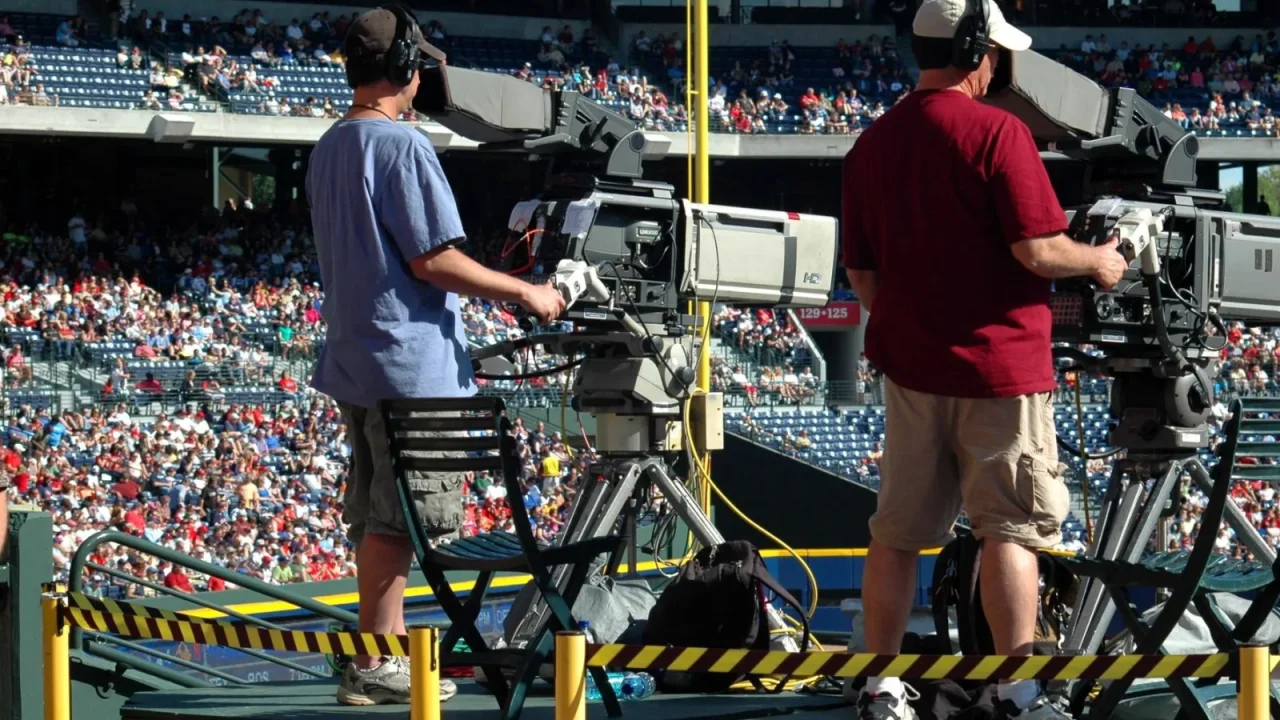
A typical stadium broadcast blends several separate microphone feeds live: commentary booth microphones, shotgun and parabolic microphones aimed at the field to catch the crack of a bat or the thud of a tackle, and dedicated ambient microphones placed around the crowd to capture the roar as its own layer. An audio engineer in the broadcast truck blends all of it in real time, adjusting each feed’s level as the game unfolds.
A film crew can reshoot a scene if a boom microphone catches too much wind noise. A stadium engineer gets one pass at a goal, a home run, or a match point, with every microphone feed active at once and no chance to rebalance afterward. That single pass constraint is the direct cause of a mix that occasionally swings further than anyone in the truck actually wanted.
Different sports lean on different parts of that blend. A tennis broadcast, played in near silence between points, relies heavily on the commentary and court microphones since crowd noise is minimal until a big point ends. An American football or soccer broadcast leans much harder on the ambient crowd microphones, since a stadium roar is part of what makes the broadcast feel live in the first place, and that same roar is what buries commentary a few seconds later.
A film’s loudest moment and quietest moment might differ by 20 decibels, carefully planned. A live match’s loudest and quietest moment can differ by considerably more than that, entirely unplanned, because nobody can script when a crowd is going to erupt.
What this actually changes in a normal living room
The practical result is commentary sitting noticeably quieter relative to crowd noise than dialogue does in a film mix, which is why so many people describe sports broadcasts as needing constant volume adjustment. This is not a fault in your soundbar or receiver. It is closer to the intended balance of the broadcast itself, just one that assumes a viewer will ride the remote.
A soundbar’s night mode or a dedicated dialogue enhancement setting exists mostly for this exact situation, compressing the gap between the quietest and loudest moments so commentary stays audible without the crowd becoming uncomfortably loud a few seconds later. How night mode and dynamic range settings actually work covers what that setting is doing to the signal, and where it falls short. If commentary specifically still gets lost under crowd noise even with night mode active, fixing dialogue that stays too quiet against effects covers the center channel and EQ side of the same problem.
The specific mistake that costs people real money
Marketing around Atmos soundbars and receivers leans hard on movies and prestige television, and it is easy to assume the same investment pays off just as directly for the football game on Sunday or the match on a weeknight. It usually does not, because there is rarely any height channel information in a live sports broadcast for a 5.1.2 or 7.1.4 layout to actually reproduce.
A customer who spent close to $1,200 upgrading from a basic soundbar to a full height channel Atmos system, expecting Sunday football to sound noticeably more three dimensional, described the result as barely different at all. The film library he also owned sounded considerably better. The live sport did not, because the broadcast simply never carried the object based information those extra speakers exist to render.
| Upgrade | Helps live sport | Helps films and prestige TV |
|---|---|---|
| Height channels or up firing speakers | Rarely, since most broadcasts carry no height data | Yes, where the title has an actual Atmos mix |
| Dedicated center channel or dialogue mode | Yes, directly addresses commentary clarity | Yes, for dialogue heavy scenes |
| Night mode or dynamic range compression | Yes, narrows the crowd versus commentary gap | Yes, useful for late night viewing |
The better spend for someone whose viewing is mostly live sport is a soundbar or receiver with a genuinely capable center channel and a dialogue enhancement mode that actually does something audible, rather than height speakers pointed at a ceiling that will rarely receive anything to bounce. What Prime Video’s own audio actually supports is worth checking directly if a specific league’s streaming package is the one being evaluated, since exclusive packages occasionally do get special audio treatment that a standard broadcast does not.
Where Atmos is starting to reach live sport anyway
ATSC 3.0, marketed to consumers as NextGen TV, is built around Dolby AC-4, a broadcast codec with the ability to carry immersive object based audio over the air for the first time. Some stations in some American cities have started using it for select live events, though coverage remains limited to specific markets and specific broadcasts rather than a general standard yet.
This is worth watching rather than buying equipment ahead of, since a NextGen TV tuner or a compatible television is only useful in a market where a broadcaster has actually switched on the immersive feed for the event you want to watch. Most households will keep watching sport in standard 5.1 for some time yet, regardless of what equipment sits underneath the TV.
The ATSC’s own documentation tracks which markets have activated NextGen TV broadcasts, and Dolby’s technology pages explain the object based approach that a genuinely immersive sports broadcast would eventually need to use. Until that becomes common, the fix for a living room where commentary keeps disappearing under crowd noise is a better center channel and a working night mode, not a taller speaker layout.
Before buying anything for sport specifically, watch one full quarter or one half with night mode or dialogue enhancement switched on. If commentary stays legible through a crowd roar without you touching the remote, the setting has already solved the actual problem.
The customer with the HW-Q990D took that suggestion instead of returning the soundbar. Switching on the bar’s own night mode for sport, and leaving Atmos processing on for everything else, ended the weekly volume wrestling without spending another dollar.
Questions readers ask about this
Rarely, though it is starting to change. Most live sport is delivered in channel based Dolby Digital or Dolby Digital Plus 5.1. A small number of broadcasts using ATSC 3.0, marketed as NextGen TV, have begun carrying immersive audio through the Dolby AC-4 codec, but this is still limited to specific stations and specific events.
Live broadcasts are balanced in real time by one engineer managing both a commentary booth and unpredictable crowd noise, unlike a film's carefully planned mix. Commentary often sits genuinely quieter relative to crowd noise than dialogue does in a scripted show, which is why a night mode or dialogue enhancement setting helps more than raising the volume overall.
Usually not by much. Height speakers reproduce object based audio information that a typical live sports broadcast does not contain, since most sport is still mixed in standard channel based 5.1. That investment pays off far more reliably for films and prestige television with an actual Atmos mix.
A soundbar or receiver with a clear, dedicated center channel and a working dialogue enhancement or night mode setting. Both directly address the gap between quiet commentary and loud crowd noise, which is the specific problem live sport audio creates, rather than adding channels the broadcast cannot use.
Sometimes, but not usually in the direction people expect. Most streamed sport arrives as Dolby Digital Plus 5.1, similar in channel layout to a cable broadcast's Dolby Digital, though bitrates and encoding can differ by platform. Checking the specific streaming service's own published audio support is more reliable than assuming streaming is automatically better.

About the author
Rahul Gupta
Rahul Gupta has spent nearly a decade quietly wiring living rooms, testing soundbars in every awkward apartment layout imaginable, and untangling the kind of HDMI handshake problems that make people give up on Atmos altogether. He writes here about what actually works when you get the boxes home—not what the spec sheet promises. If a piece of gear on this site earns a recommendation, it earned it in a real room with real furniture, not a lab.